
London Tube strikes April 2026: full dates and travel impact
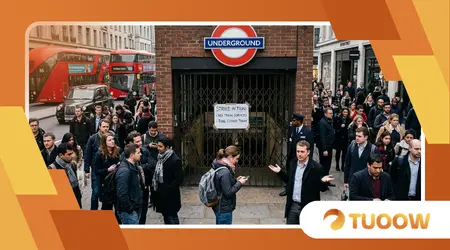
The London Tube strikes April 2026 represent one of the most significant challenges to the capital’s transport infrastructure this year.
For anyone who naviagtes the labyrinthine tunnels of the London Underground daily, the sudden silence of the platforms is more than a mere inconvenience; it is a logistical hurdle that requires military-grade planning.
This week, as members of the RMT union initiate a two-phase walkout, the city’s pulse has slowed, forcing millions to rethink their commutes, school runs, and business meetings.
The core of the dispute rests on proposed changes to working arrangements, specifically a move toward a condensed four-day working week.
While Transport for London (TfL) maintains these changes would be voluntary, the RMT has raised concerns regarding shift lengths and the potential erosion of annual leave entitlements.
This ideological and contractual deadlock has manifested in a series of 24-hour stoppages that have effectively partitioned the network, leaving some lines completely dormant while others struggle under the weight of reduced staffing.
Navigating the April 2026 Strike Schedule
- Midday Walkouts: Understanding the 12:00 to 12:00 rolling schedule.
- Line Status: Identifying the complete closures on the Piccadilly and Circle lines.
- Travel Alternatives: Maximising the Elizabeth line, DLR, and River Bus services.
- Rights and Refunds: Navigating the complexities of compensation for season ticket holders.
Understanding the timeline of the London Tube strikes April 2026 is the first step in reclaiming your week. Unlike previous actions that followed a simple 24-hour cycle, this industrial action is staggered.
The walkouts are timed from midday to midday, which creates a peculiar “rolling” disruption that affects two peak periods within a single 24-hour block.
This strategy is designed to maximise impact while perhaps allowing for some morning stability before the gates are locked.
For those planning their week, the specific dates are Tuesday 21 April, where action began at 12:00, through to midday on Wednesday 22 April.
A second, identical phase is scheduled to begin at 12:00 on Thursday 23 April, lasting until midday on Friday 24 April.
It is vital to note that even when the strike officially ends at noon, the “ramp-up” of services is a slow process.
Rolling stock must be moved from depots, and staff must be in position, meaning that full services rarely resume until the following morning.
++ Local council bankruptcies UK 2026: causes and consequences
Line-by-Line Impact and Closures
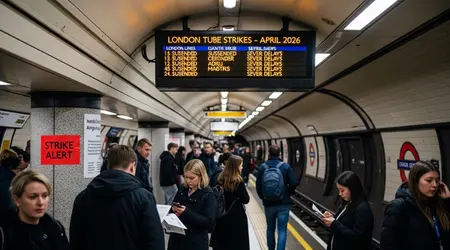
The disruption during the London Tube strikes April 2026 is not uniform across the network.
Certain lines have been designated as “no service” zones due to the concentration of union membership or the specific operational requirements of those routes.
Commuters should prepare for a complete absence of trains on the Piccadilly and Circle lines.
This creates a significant vacuum in central London, particularly for those who rely on the Circle line to hop between major rail termini like Paddington, Victoria, and King’s Cross St Pancras.
The Waterloo & City line is also expected to be entirely closed, complicating the “drain” commute for City workers.
Other lines, including the Central and Metropolitan lines, are facing partial closures.
Specifically, the Central line is suspended between White City and Liverpool Street, effectively severing the east-west artery of the city.
On the Metropolitan line, no service is expected between Baker Street and Aldgate.
For all other lines, a “reduced service” is the official stance, though in practical terms, this often means waits of 20 minutes or more on platforms that are dangerously overcrowded.
Alternative Transport Strategies
When the Underground fails, Londoners typically turn to the bus network, but during the London Tube strikes April 2026, this carries its own set of risks.
While most bus services are running, they are operating at a significantly higher capacity.
A journey that usually takes 30 minutes on the Tube can easily stretch to 90 minutes on a bus as it crawls through the increased surface traffic.
If you must use the bus, aim for the very early morning or mid-afternoon to avoid the worst of the congestion.
The London Overground, Elizabeth line, and DLR remain unaffected by this specific RMT action, serving as vital lifelines.
The Elizabeth line, in particular, has become the “hero” of strike days, offering a high-capacity alternative for those travelling across the city.
However, be aware that stations where these lines interface with the Underground such as Stratford, Canary Wharf, or Bond Street will be exceptionally busy.
You may find that certain station entrances are closed to manage crowd safety, even if the trains themselves are running.
Summary of Travel Impacts and Alternatives
| Category | Status/Impact | Advice for Commuters |
| Piccadilly & Circle Lines | Fully Closed | Use the Elizabeth line or bus alternatives. |
| Central Line | No service (White City to Liverpool St) | Use the Elizabeth line or London Overground. |
| Metropolitan Line | No service (Baker Street to Aldgate) | Use Chiltern Railways or walking routes. |
| Elizabeth Line / DLR | Running Normally | Expect extreme overcrowding; allow extra time. |
| London Buses | Running Normally | Significant delays due to surface traffic congestion. |
| River Services | Increased Capacity | Consider the Uber Boat for scenic, reliable travel. |
The Economic and Social Toll of Industrial Action
The broader implications of the London Tube strikes April 2026 extend beyond personal frustration.
Economists often cite a loss of millions of pounds in daily productivity when the capital’s transport system falters.
For the hospitality and retail sectors, which rely on the evening economy, the 8:00 PM “service wind-down” on strike days is particularly damaging.
Many theatres and restaurants in the West End report significant booking cancellations, as patrons fear being stranded without a reliable way home.
From a public policy perspective, these strikes highlight the fragility of London’s reliance on a single transport mode.
The ongoing negotiations between TfL and the RMT are a microcosm of the changing nature of work post-2020.
The “four-day week” proposal is part of a wider trend toward flexible working, yet the friction it causes in a unionised environment like the Underground shows that implementation is far from simple.
It is a reminder that behind the automation and the iconic roundels, the system is still entirely dependent on human labour and complex industrial relations.
Also read: Biggest Overhaul of UK Migration Model in 50 Years
Looking Ahead: May and June 2026
It is important for travellers to realise that the London Tube strikes April 2026 are not an isolated event. If negotiations remain stalled, a further series of strikes has already been earmarked for May and June.
The scheduled dates for May are the 19th through to the 22nd, following the same midday-to-midday pattern. June is set to see similar disruption between the 16th and 19th.
This suggests a protracted summer of discontent unless a breakthrough is achieved in the coming weeks.
Staying informed through official channels like the TfL website and National Rail Enquiries is essential. These platforms provide real-time updates and “re-routing” tools that can save you hours of wasted time.
Additionally, check for localised “bus garage” disputes, as these can occasionally coincide with Tube strikes, further complicating the “Plan B” for many commuters.
Transparency and preparation are your best tools in navigating a city that is partially under lock and key.
Rights to Compensation and Delay Repay
For many, the question of compensation arises during the London Tube strikes April 2026.
While TfL typically does not offer “Delay Repay” for strikes that are announced in advance, there are nuances if you hold a season ticket or if your journey was disrupted by a failure of a “running” service.
If you are using National Rail services to complete your journey, different rules apply. Always keep your tickets and make a note of your exact journey times, as these will be required if you intend to file a claim through the National Rail or TfL portals.
Consulting official guidance on GOV.UK regarding passenger rights can provide clarity on what is and isn’t covered.
It is often a complex legal area, and for those with significant financial losses due to travel failure, seeking advice from consumer rights groups or professional travel coordinators may be necessary.
However, for the average commuter, the focus should remain on mitigation: working from home where possible or finding that elusive “walking route” that avoids the tunnels altogether.
Read more: Brit Awards 2026 Moves to Manchester: Cultural and Economic Impact Outside London
Practical Advice for the “Strike-Proof” Commute
The most effective way to handle the London Tube strikes April 2026 is to eliminate the need for the Tube entirely.
For those within Zone 1 and 2, walking or cycling has become the preferred choice for the “strike-hardened” Londoner.
Santander Cycles known affectionately as Boris Bikes are often in high demand, so checking the app for dock availability is a must.
If you are cycling, be prepared for much busier roads, as drivers who usually take the train also take to the asphalt.
If working from home is not an option, consider the “River Bus.” The Thames Clippers (Uber Boat) offer a reliable and often overlooked way to bypass the central congestion.
While the fares are higher than a standard Tube journey, the reliability and comfort are a welcome reprieve from the chaos of a strike day.
In 2026, versatility is the hallmark of a successful London commute; those who can switch between boat, bike, and bus with ease are the ones who avoid the most stress.
Planning for a Resilient Future
The London Tube strikes April 2026 serve as a poignant reminder of the intricate balance required to keep a global city moving.
While the immediate impact is one of frustration and delay, the underlying issues regarding work-life balance and fair compensation are central to the future of the UK’s labour market.
For the commuter, the takeaway is the importance of adaptability.
By diversifying your transport options and staying informed through official sources, you can navigate these disruptions with minimal impact on your professional and personal life.
As we look toward the potential walkouts in May and June, the lessons learned this week will be invaluable in maintaining your mobility in an ever-shifting urban landscape.
Reflect on your travel patterns and perhaps find a new favourite walking route or cycle path it might just be the most reliable way to travel in 2026.
Frequently Asked Questions (FAQ)
Can I use my Tube ticket on the bus during the London Tube strikes April 2026?
Generally, yes. During major strikes, TfL often implements “ticket acceptance” on alternative routes, including buses and some National Rail services.
However, you should check the TfL status updates for the specific day, as this is usually confirmed on a case-by-case basis depending on the severity of the closure.
Will the Elizabeth line be affected by the Tube strike?
No, the Elizabeth line is operated under a different contract and is not part of this specific RMT walkout.
It is expected to run a normal service, though it will be significantly busier than usual as it absorbs passengers from the suspended Underground lines.
Is there a “last train” I should aim for on strike days?
On Tuesday 21 April and Thursday 23 April, services will begin to ramp down around 11:00 AM.
TfL recommends that you aim to have completed your journey by 8:00 PM on those evenings, as most stations will be closed or operating with extremely limited staff after that time.
Are the strikes affecting the airports, such as Heathrow or Gatwick?
The Gatwick Express and Heathrow Express are running normally. However, the Piccadilly line a major route to Heathrow is suspended.
Travellers to Heathrow should use the Elizabeth line or the Heathrow Express from Paddington instead. For Gatwick, Southern and Thameslink services from Victoria and London Bridge are operating as usual.
How can I find out if my local station is open?
The best way is to use the TfL “Plan a Journey” tool or the “Status Updates” page. On strike days, stations may close at short notice due to staffing levels or overcrowding.
Checking the real-time feed on social media (X/Twitter) via @TfL is often the quickest way to get localised station news.
