
How UK Schools are Redefining Intelligence in the Age of Generative AI
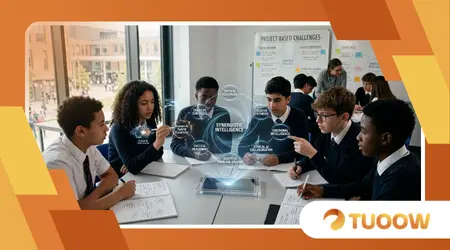
The traditional British classroom, long defined by the scratch of fountain pens and the rigorous memorisation of the Kings and Queens of England, is undergoing a quiet but profound revolution.
As large language models become as accessible as a pocket calculator, the Department for Education (DfE) and institutions across the United Kingdom are facing a fundamental question: what does it mean to be “intelligent” in 2026?
The answer is shifting away from the mere retrieval of facts and moving towards a sophisticated model of cognitive partnership.
For decades, the UK education system has been built upon the foundation of a “knowledge-rich curriculum,” championed by various education secretaries to ensure academic rigour.
However, the emergence of generative tools has blurred the lines between human effort and algorithmic output.
To navigate this, educators are now prioritising AI literacy in UK schools, ensuring that pupils do not just use these tools, but understand the mechanics, ethics, and limitations behind them.
This shift represents a transition from viewing technology as a peripheral aid to seeing it as a core competency.
The Shift from Memorisation to Critical Evaluation
In the past, a student’s academic prowess was often measured by their ability to synthesise vast amounts of information under exam conditions.
While the Joint Council for Qualifications (JCQ) still maintains strict regulations regarding “AI use in assessments,” there is a growing acknowledgment that total prohibition is a short-term sticking point.
The real world does not operate in a vacuum, and neither should the classroom.
Intelligence is being redefined as “evaluative judgement” the ability to look at an AI-generated essay and spot the subtle hallucinations or biases within it.
This shift is not about lowering standards; if anything, it raises the bar for the modern student.
Pupils are now expected to act as editors-in-chief of their own work, verifying claims against primary sources and injecting a unique authorial voice that a machine cannot replicate.
This process is at the heart of AI literacy in UK schools, moving beyond basic digital skills into the realm of high-level cognitive scrutiny.
By understanding how a transformer model predicts the next token in a sentence, students gain a better grasp of human linguistics and logic.
++ Alternative provision schools UK 2026: support for excluded pupils
Navigating the Ethical Landscape and Digital Divide
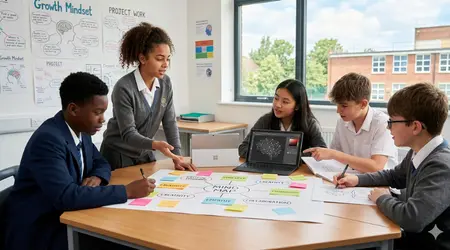
The integration of advanced technology in education inevitably brings ethical dilemmas to the forefront of the staffroom.
The UK government’s “Generative AI in Education” call for evidence highlighted concerns regarding data privacy, intellectual property, and the potential for “algorithmic bias” to influence young minds.
Teachers are now tasked with explaining to twelve-year-olds why an AI might produce a stereotypical image or a skewed historical narrative.
This ethical education is a vital component of modern schooling, ensuring that the next generation of British workers is principled.
A significant risk in this transition is the widening of the digital divide across the country.
While affluent independent schools might have the resources to implement bespoke AI tutors, state schools in less advantaged areas may struggle with basic hardware requirements.
To address this, organisations like Jisc and the National Grid for Learning are working to provide equitable access to tools and training.
Strengthening AI literacy in UK schools must be a universal endeavour; otherwise, we risk creating a two-tier society where only those who can afford “cognitive offloading” have the time to pursue creative tasks.
Practical Implementation: A Guide for Educators
Implementing these changes requires more than just a new software subscription; it requires a cultural shift within the school community.
Teachers are no longer the sole gatekeepers of knowledge; they are facilitators of inquiry. For a school to successfully modernise, it must move through several stages of integration.
This begins with demystifying the technology for staff, many of whom may feel overwhelmed by the pace of change since the 2023 surge in generative tools, ensuring they feel confident in their role.
The transition is already visible in classrooms from Cornwall to Cumbria.
In some Sixth Form colleges, students are encouraged to use AI to generate “counter-arguments” to their own debates, forcing them to defend their positions with greater rigour.
In primary schools, children use AI-generated imagery to spark creative writing prompts, using the visual output as a springboard for their own descriptive vocabulary.
These practical applications show that AI literacy in UK schools is not a separate subject but a thread woven through the entire fabric of the British educational experience.
| Stage of Integration | Objective | Practical Action |
| Phase 1: Awareness | Understanding the “Why” | Staff workshops on AI capabilities and limitations. |
| Phase 2: Policy | Safeguarding and Integrity | Updating “Acceptable Use Policies” to include AI guidelines. |
| Phase 3: Curriculum | Skill Development | Embedding prompt engineering and fact-checking into subjects. |
| Phase 4: Transformation | Redefining Assessment | Moving towards viva voce (oral exams) or supervised in-class work. |
The Future of Assessment and the Workforce
As we look toward the 2030s, the very structure of the British exam system may need to change.
The current reliance on end-of-year high-stakes testing is being challenged by the reality that “knowledge” is now a commodity.
Ofqual and the various exam boards are exploring more “authentic assessments” tasks that mirror the complexities of the real world.
This might include project-based learning where the use of AI is not only allowed but expected, provided the student can document their process and justify their editorial choices.
The ultimate goal of redefining intelligence in schools is to prepare students for a workforce that is still being defined.
The World Economic Forum and the Bank of England have both noted that “soft skills” empathy, leadership, complex problem-solving, and adaptability will be the most valuable assets in an automated economy.
By focusing on these human-centric traits, UK schools are ensuring that their leavers are not just technically proficient, but also emotionally intelligent and resilient enough to navigate a shifting landscape.
Also read: Free School Projects Scrapped to Fund SEND Support: The Real Story Behind the Policy Shift
Embracing the Cognitive Partnership
The redefinition of intelligence in UK schools is not a sign of human decline, but a testament to our adaptability.
By embracing a partnership with generative AI, we are peeling back the layers of rote learning to reveal the true core of education: the development of a curious, critical, and ethical mind.
This journey is complex and requires constant vigilance regarding equity and integrity, but the potential rewards for the nation’s youth are immense as they prepare for a digital-first future.
We are moving towards a future where “being smart” means having the wisdom to navigate a world of infinite information.
As schools continue to integrate these technologies, the focus must remain on the human element.
Technology will change, models will be updated, and hardware will evolve, but the need for a solid foundation in critical thinking and ethical reasoning remains constant.
The evolution of British education is well underway, and it is a path that promises a more thoughtful, creative, and capable generation.
Frequently Asked Questions
Does using AI in school count as plagiarism?
It depends on the context and the school’s policy. The JCQ (Joint Council for Qualifications) states that if a student submits AI-generated work as their own, it is considered malpractice.
However, using AI as a research tool or to help structure ideas is increasingly seen as a valid skill, provided it is properly cited and the final output is the student’s original work.
This distinction is vital for maintaining academic standards in the modern age.
How can parents support AI literacy at home?
Parents should encourage an “inquisitive but sceptical” mindset. If a child uses AI for homework, ask them to explain how they know the information is correct.
Discussing the “hallucinations” of AI and checking facts in traditional books or reputable websites like the BBC or GOV.UK is a great way to build critical thinking.
Engaging with the technology together can demystify the process and highlight its limitations.
Will AI replace teachers in the UK?
Unlikely. The DfE emphasises that technology should “augment” rather than “replace” the teacher.
The role of the teacher as a mentor, role model, and emotional support is something that an algorithm cannot replicate.
AI is best used to handle repetitive tasks, giving teachers more time to focus on student well-being and complex instruction. The human connection remains the cornerstone of effective education.
What skills should my child focus on for an AI-driven future?
While technical skills are useful, “human” skills are paramount. Focus on critical thinking, ethical reasoning, advanced communication, and the ability to work collaboratively.
Understanding how to manage and direct AI (prompting and auditing) will also be a vital skill in almost every sector of the UK economy.
Schools are increasingly shifting their focus to these competencies to ensure long-term career success for their students.
