
Bayeux Tapestry UK return: why Macron’s London visit matters
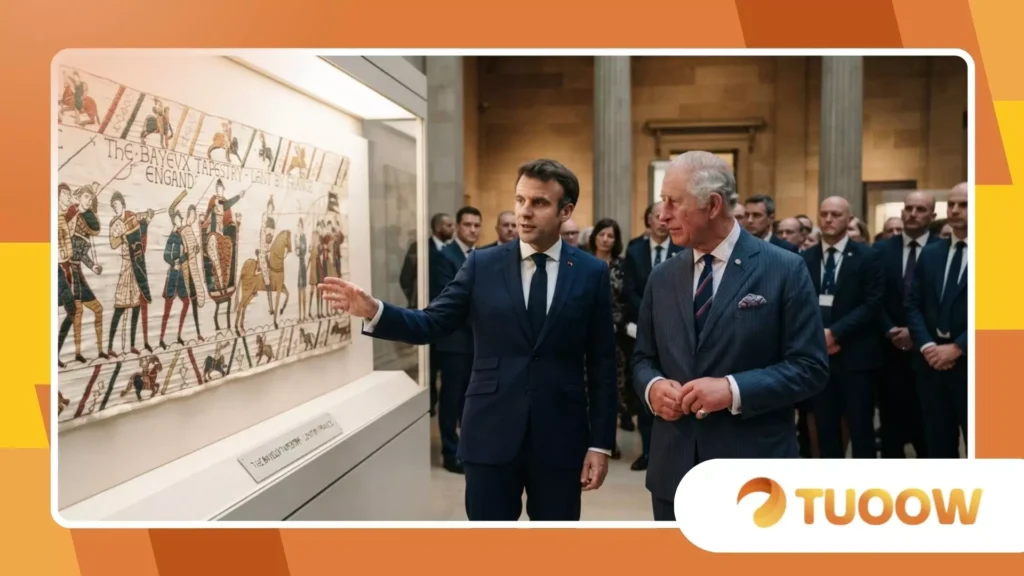
The diplomatic relationship between the United Kingdom and France has historically been defined by moments of strategic rivalry, shared security concerns, and profound cultural alignment.
When French President Emmanuel Macron conducts a bilateral state or summit visit to London, the ceremonial agenda often hides deeply calculated geopolitical motives.
Few cultural topics capture the public imagination as powerfully as the potential Bayeux Tapestry UK return, a historic gesture that promises to redefine cross-Channel relations in a post-Brexit landscape.
This detailed exploration examines why President Macron’s visits to London represent far more than routine diplomatic photo opportunities.
By linking soft-power cultural loans with hard-power security, trade, and border management negotiations, both nations leverage shared history to unlock modern diplomatic solutions.
Below is a comprehensive breakdown of how a seventy-metre embroidered masterpiece became a central bargaining chip in contemporary European diplomacy.
What This Article Covers
- Diplomatic Strategy: How soft power and cultural loans serve as levers in UK-France bilateral talks.
- Logistical Realities: Conservation constraints, climate control, and insurance requirements for moving a fragile 11th-century artefact.
- Political Dynamics: The balance between post-Brexit trade arrangements, Channel migration, and state ceremonial visits.
- Cultural Significance: The historical links between Normandy and Anglo-Saxon England represented in the embroidery.
- Comparative Outlook: Key metrics regarding loan conditions, timeline projections, and institutional frameworks.
The Intersection of Soft Power and Hard Diplomacy
Diplomatic engagements between Downing Street and the Élysée Palace operate simultaneously across multiple tiers.
While headlines frequently focus on defence agreements, cross-Channel migration policy, or financial regulations, cultural exchange remains the emotional foundation of international relations.
A proposed cultural loan, particularly one involving an object of monumental national significance, creates a unique atmosphere of goodwill that lubricates difficult political conversations.
When President Macron visits London, the ceremonial framing is designed to project stability and mutual respect.
Cultural initiatives allow leaders to signal cooperative intent to domestic audiences without immediately conceding ground on controversial policy matters.
By placing shared heritage at the centre of high-level talks, both governments establish a constructive environment for addressing complex economic and security disputes.
The use of historic artefacts as instruments of statecraft is a well-established practice in European history. However, the diplomatic weight assigned to a potential Bayeux Tapestry UK return carries unparalleled symbolic value.
It bridges nearly a millennium of intertwined British and French history, transforming an ancient record of conquest into a modern instrument of diplomatic collaboration.
Navigating the Technical and Conservation Challenges
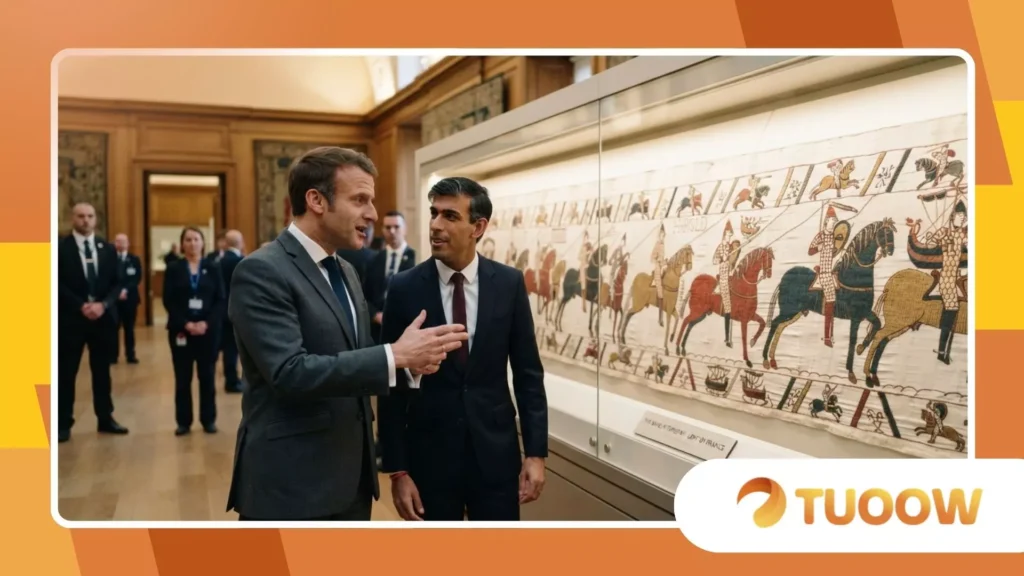
While the political will to loan the medieval masterpiece may exist at the highest levels of government, the physical reality of moving a fragile 950-year-old textile presents immense technical hurdles.
The artefact consists of embroidered woollen yarns on a plain-weave linen background, stretching over nearly seventy metres in length.
Over centuries, exposure to light, humidity fluctuations, and physical stress has rendered the fabric exceptionally vulnerable to decay.
Conservation specialists from the French Ministry of Culture and British cultural institutions, such as the British Museum, must conduct rigorous structural audits before any transport plan can be authorized.
The textile exhibits numerous micro-tears, historical repair work, and environmental degradation that require meticulous stabilization.
Moving such an object across the English Channel involves state-of-the-art climate-controlled transport cases, vibration-dampening suspension systems, and extensive security protocols.
Beyond physical transportation, the host venue in the United Kingdom must satisfy stringent environmental and safety criteria.
Exhibition spaces require specialized lighting systems emitting zero ultraviolet radiation, sophisticated security infrastructure, and continuous atmospheric monitoring.
The financial cost of insuring and securing the artefact runs into tens of millions of pounds, necessitating direct government backing through formal legislative indemnity frameworks.
++ NHS Workforce Crisis: Hospitals Continue to Face Staff Shortages Across England
Strategic Timing: Why London Visits Drive Bilateral Momentum
State visits and diplomatic summits are meticulously timed to coincide with broader geopolitical objectives.
When President Macron meets the British Prime Minister in London, every agenda item is strategic.
Cultural announcements are rarely standalone gestures; they are deployed to cushion tougher discussions regarding border enforcement, energy infrastructure, and European defense integration.
For the United Kingdom, hosting a historic cultural loan signals that post-Brexit diplomatic isolation is a misconception and that strong bilateral partnerships with key European Union members remain robust.
For France, agreeing in principle to loan a treasured national asset demonstrates leadership within European cultural diplomacy while securing tangible commitments from London on shared maritime security and intelligence operations.
The discussion surrounding a potential Bayeux Tapestry UK return illustrates how historical narratives can be repurposed to serve modern strategic interests.
By linking a medieval depiction of the 1066 Norman Conquest to 21st-century diplomacy, both nations acknowledge that their shared security and economic futures are irrevocably linked, regardless of changing political alignments in Westminster or Paris.
Also read: Biggest Overhaul of UK Migration Model in 50 Years
Policy Metrics and Institutional Frameworks
Executing a international loan of this magnitude requires formal bilateral agreements that extend beyond standard museum-to-museum contracts.
Government departments including the Department for Culture, Media and Sport (DCMS) in the UK and the Direction générale des patrimoines in France must establish joint oversight committees to manage legal, financial, and logistical responsibilities.
| Operational Dimension | UK Governance & Obligations | French Governance & Obligations |
| Legal Framework | Parliamentary Approval & Immunity from Seizure | Parliamentary Authorisation & National Heritage Clearance |
| Financial Support | DCMS Indemnity Scheme & Special Exhibition Funding | Ministry of Culture Restoration & Transport Subsidies |
| Conservation Science | British Museum Restoration Team Collaboration | C2RMF (Centre de Recherche et de Restauration) Lead |
| Security & Logistics | Metropolitan Police & Specialist Escort Units | Police Nationale & Guarding Protocols |
These structural mechanisms ensure that international heritage loans remain insulated from sudden political shifts.
The multi-layered approval process guarantees that conservation standards remain the primary deciding factor, ensuring that political enthusiasm does not jeopardize the physical integrity of irreplaceable historical items.
Read more: Brit Awards 2026 Moves to Manchester: Cultural and Economic Impact Outside London
The Broader Impact on Bilateral Relations
The diplomatic reverberations of President Macron’s visits extend far beyond heritage conservation.
When bilateral talks succeed in integrating cultural milestones with substantive policy outcomes, the broader relationship between London and Paris strengthens.
Key sectors benefiting from enhanced diplomatic momentum include joint scientific research, defence technology sharing under the Lancaster House Treaties framework, and coordinated energy security initiatives.
Ultimately, high-profile diplomatic summits demonstrate that symbolic statecraft and practical policy negotiation are complementary tools.
A successful agreement regarding a temporary Bayeux Tapestry UK return provides a visible, popular triumph for both leaders, reinforcing the idea that geographic proximity and historic ties create an enduring obligation for strategic partnership across the English Channel.
Conclusion and Strategic Outlook
The diplomacy surrounding President Emmanuel Macron’s visits to London highlights the enduring relevance of soft power in international relations.
While modern governance requires constant attention to economic metrics, security protocols, and trade policy, cultural symbols remain uniquely capable of capturing the public imagination and unifying historic allies.
The potential loan of the Bayeux Tapestry represents the pinnacle of cross-Channel cultural exchange.
By balancing rigorous conservation standards with strategic statecraft, both the United Kingdom and France demonstrate that shared history can serve as a catalyst for future cooperation.
As bilateral discussions continue to evolve, the ability to blend medieval heritage with modern diplomatic priorities will remain a defining feature of UK-French relations
Frequently Asked Questions
Has the tapestry ever returned to the UK since 1066?
There is no definitive historical record of the tapestry returning to English soil since its creation in the late 11th century, which scholars generally believe occurred in Kent.
It has remained in Normandy for centuries, primarily housed in Bayeux, making any prospective loan to the United Kingdom an unprecedented historical event.
What are the main conservation risks preventing the loan?
The primary risks involve structural stress on ancient linen fibres during transit, fluctuations in relative humidity causing fabric contraction or expansion, and potential degradation from ambient light exposure during public display.
Specialists require absolute environmental stability before approving transport.
How does a cultural loan impact political negotiations between the UK and France?
Cultural loans serve as key instruments of soft power.
They generate political goodwill and positive public engagement, creating a favorable diplomatic atmosphere that helps leaders negotiate more contentious issues, such as maritime border security, post-Brexit trade arrangements, and defence cooperation.
Which British institution would display the tapestry if the loan takes place?
The British Museum in London is the primary candidate equipped with the security infrastructure, climate-controlled environments, and floor space required to display a seventy-metre textile safely, though regional institutions with historical ties to 1066 have also been proposed.
