
DWP bank account monitoring 2026: how new checks may work

The landscape of the British welfare system is undergoing a significant digital shift. For millions of claimants across the United Kingdom, keeping up with legislative updates is vital to ensuring financial stability.
A topic generating considerable discussion is the proposed expansion of powers for the Department for Work and Pensions (DWP), specifically regarding how fraud and error are tackled within the benefits system.
At the heart of this discussion is the concept of DWP bank account monitoring.
While the government aims to reduce losses to the taxpayer, many claimants are understandably concerned about what these measures mean for their personal privacy.
Understanding the mechanics of these proposed checks, the targeted benefits, and the legal safeguards is essential for anyone navigating the welfare system today.
The Evolution of Benefit Verification
Historically, verifying a claimant’s financial eligibility has been a reactive process.
The DWP typically requests bank statements during initial applications, routine reviews, or when a specific fraud tip-off occurs.
This traditional method relies heavily on self-reporting and random audits, which can lead to delays in identifying overpayments or fraudulent claims.
Under the evolving legislative framework, the government aims to shift toward a proactive model.
Rather than waiting for a red flag, the proposed system introduces a duty on financial institutions to assist the DWP.
This means banks and building societies would be required to look for specific markers that suggest a claim might be incorrect, signaling a major shift in how welfare eligibility is maintained.
The primary drivers behind this shift are efficiency and fiscal responsibility.
According to official GOV.UK fraud and error reports, billions of pounds are lost annually due to undisclosed capital and prolonged overseas stays.
By modernising their approach, policymakers intend to create a more resilient welfare state while ensuring that public funds are directed precisely to those who meet the statutory criteria.
++ State Pension underpayment UK 2026: who could claim thousands
How Will the New Checks Work in Practice?
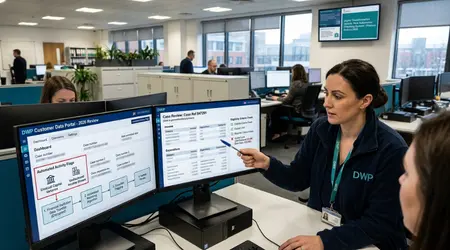
A common misconception is that the government will have direct, unrestricted access to look into your bank account at any time.
Official policy briefings from the DWP indicate this is not the case. Instead, the mechanism relies on a system of automated flags generated by the banks themselves.
The process is designed to operate through a high-level data match. The DWP provides a list of names to participating financial institutions.
The banks then run automated checks against their databases to identify accounts that breach specific welfare criteria.
If an account triggers a flag, only the basic identifying data is sent back to the DWP for human review.
No money will be automatically deducted, and benefits cannot be stopped solely based on an automated alert.
The DWP bank account monitoring system functions as an early warning mechanism.
Once an alert is received, a DWP caseworker must independently investigate the case, contact the claimant, and request the relevant financial records before taking any formal action.
What Key Triggers Will Banks Look For?
The automated checks are designed to identify specific breaches of benefit rules. For the vast majority of claimants who report their circumstances accurately, these background checks will run without generating any alerts.
The system primarily focuses on two main areas of non-compliance: capital limits and overseas residency rules.
Capital Limit Breaches
For means-tested benefits like Universal Credit, there is a strict capital ceiling. Currently, if a claimant’s savings exceed £16,000, eligibility for the benefit ceases entirely.
Savings between £6,000 and £16,000 result in a tapered reduction of the monthly payment.
The automated banking checks will look for account balances that consistently exceed these thresholds without having been declared to the DWP.
The Overseas Rule
Most UK benefits have strict rules regarding how long a recipient can spend abroad while continuing to collect payments.
For instance, Universal Credit claimants are generally allowed to go abroad for up to one month, provided they continue to meet their commitment conditions.
Banks can detect continuous overseas ATM withdrawals or foreign transactions, which could trigger a flag indicating the account holder has been outside the UK longer than permitted.
Also read: What the End of Income Support and Jobseeker’s Allowance Means for Claimants in 2026
Which Benefits Are Mainmost Targeted?
The proposed expansion of powers does not apply uniformly to every type of state support.
The legislation primarily focuses on means-tested benefits, where an individual’s income and savings directly dictate their entitlement.
Contributory or non-means-tested benefits are generally subject to fewer financial restrictions.
| Benefit Type | Subject to Capital Checks? | Subject to Residency Checks? | Primary Focus of Monitoring |
| Universal Credit | Yes | Yes | Capital exceeding £16,000 and undeclared earnings. |
| Employment and Support Allowance (Income-Related) | Yes | Yes | Unreported savings and capital thresholds. |
| Jobseeker’s Allowance (Income-Based) | Yes | Yes | Verifying financial hardship criteria. |
| Pension Credit | Yes | Yes | Undisclosed assets and extended foreign travel. |
| State Pension | No | No | Exempt from standard means-testing rules. |
As shown in the table, the DWP bank account monitoring initiatives are highly targeted.
State Pensioners, for example, do not face savings limits, meaning their accounts are not the focus of capital verification checks.
The primary objective is to safeguard means-tested funds, where the risk of error relating to undeclared assets is statistically at its highest.
Privacy, Data Protection, and Legal Safeguards
The prospect of financial monitoring has raised valid concerns among privacy advocates and civil liberties groups.
Organisations like Big Brother Watch have actively debated these measures, questioning the proportionality of mass data screening.
In response, both the DWP and regulatory bodies like the Information Commissioner’s Office (ICO) have emphasised that strict legal frameworks will govern the entire process.
Under the UK General Data Protection Regulation (UK GDPR), any data processing must be lawful, fair, and transparent.
The DWP cannot engage in “fishing expeditions” or browse transaction histories out of curiosity.
Financial institutions are legally bound to protect customer data, meaning they will only share information when a specific, legally defined trigger condition has been met.
Claimants should remember that these proposals do not grant caseworkers the power to view individual itemised receipts or track daily shopping habits.
The system looks for macro-level data such as total balance figures and prolonged international transaction locations to ensure compliance with welfare laws.
Furthermore, the principle of human intervention is built into the framework. If an anomaly is detected, the DWP must follow a formal process.
This includes giving the claimant an opportunity to explain the discrepancy, submit their own evidence, and appeal any decisions regarding benefit adjustments.
Practical Guidance for Claimants
Navigating welfare changes can feel overwhelming, but staying compliant is straightforward if you maintain accurate records.
The introduction of more sophisticated verification methods highlights the importance of proactive communication with the DWP.
The most effective way to prevent false positives or unexpected account flags is to report changes in your circumstances immediately through your online journal or by contacting your local Jobcentre Plus.
If your savings fluctuate near the £6,000 threshold, or if you receive a lump sum such as an inheritance or compensation payment, declaring it promptly ensures your claim is calculated correctly from the outset.
Additionally, if you plan to travel outside the UK, ensure your trip falls within the allowed guidelines for your specific benefit. Inform your work coach before you leave to avoid flags related to the overseas rule.
Keeping clear copies of bank statements, travel bookings, and receipts for major expenses provides a solid paper trail should the DWP ever require clarification regarding your financial standing.
Read more: Council Budgets and Welfare Reform: How Local Authorities Are Preparing for New Benefit Pressures
Navigating Complex Financial Situations
Welfare regulations can become complex when dealing with joint accounts, trust funds, or money held on behalf of a dependent.
For example, if you hold money in a bank account that belongs to a relative, the automated system may initially flag that capital as your own.
Resolving these issues requires clear documentation proving the legal ownership and intent of the funds.
Because every individual’s financial situation is unique, relying solely on general online guidance may not always be sufficient.
If you find yourself facing an intricate financial dilemma or if your benefits have been suspended due to an account flag, seeking professional advice is highly recommended.
Organisations like Citizens Advice, Welfare Rights UK, or qualified legal professionals can offer tailored assistance based on your specific circumstances.
They can help you understand your rights, draft formal responses to the DWP, and guide you through the statutory appeals process if you believe an error has been made.
Adapting to a Digital Welfare System
The expansion of DWP bank account monitoring represents a clear shift toward a automated, data-driven approach to welfare administration in the United Kingdom.
While the government views these measures as an essential step toward reducing fraud and protecting public revenue, they also require claimants to be more vigilant and diligent regarding their financial reporting.
Ultimately, the core rules governing benefit eligibility have not changed; only the methods used to verify them are evolving.
By understanding how these automated checks function, keeping accurate records, and reporting changes promptly, you can ensure your transition through these legislative updates remains smooth and problem-free.
Stay informed, use official resources like GOV.UK for policy updates, and seek independent advice whenever you encounter complex financial situations.
Frequently Asked Questions (FAQ)
Can the DWP see what I spend my money on every day?
No. The proposed monitoring system does not allow the DWP to see an itemised list of your daily purchases or retail habits.
The automated checks are strictly designed to identify high-level account markers, such as whether your total savings exceed the legal limit (£16,000) or if your account is being accessed continuously from outside the UK.
Will my benefits be stopped automatically if a flag is raised?
No, benefits cannot be stopped automatically by an algorithmic system. If a bank account generates a flag, that information is passed to a human caseworker at the DWP.
The caseworker is then required to investigate the matter, contact you for clarification, and review your financial evidence before making any decisions regarding your entitlement.
Does this monitoring apply to the State Pension?
No. The new monitoring measures are aimed primarily at means-tested benefits like Universal Credit, where capital limits and residency rules directly affect your eligibility.
Since the State Pension is a non-means-tested benefit based on National Insurance contributions, it is not subject to the same savings audits.
What should I do if my savings temporarily go over the limit?
If your savings rise above £6,000 or £16,000 even temporarily due to a windfall, inheritance, or back-payment you must report this change to the DWP immediately.
Reporting the fluctuation yourself ensures your benefit payments are adjusted accurately and prevents an automated bank flag from triggering a fraud investigation.
