
OECD Warns of Slower UK Economic Growth Through 2026: What This Means for Public Spending and Private Sector

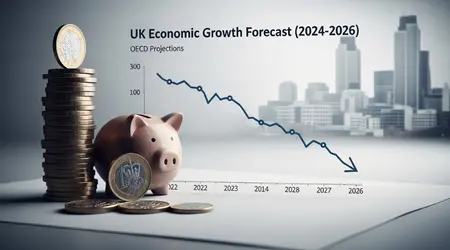
The OECD Warns of Slower UK Economic Growth Through 2026, a forecast released this December 2025, sending ripples across Westminster and the City.
This projected slowdown, driven by persistent inflation and high interest rates, presents significant challenges for policymakers.
The report emphasizes the need for disciplined fiscal management and targeted structural reforms.
This deceleration in Gross Domestic Product (GDP) growth will inevitably force difficult decisions regarding essential public services and taxation.
Why is the OECD Projecting a Deceleration in UK Growth?
The Organisation for Economic Co-operation and Development (OECD) bases its cautious outlook on several converging economic pressures unique to the UK market.
The primary headwinds are persistent supply-side constraints and tight monetary policy. High inflation, while easing, has necessitated sustained high interest rates from the Bank of England.
This policy aims to curb demand but simultaneously cools investment and consumption, resulting in the OECD Warns of Slower UK Economic Growth Through 2026.
What Specific Factors are Dampening UK Economic Momentum?
Wage-price spiral risks remain elevated, fueling core inflation expectations.
This compels the Bank of England to maintain its restrictive stance for longer than some peers. Higher borrowing costs directly impact mortgage holders and business investment.
Secondly, structural labor market shortages persist across key sectors, constraining productivity gains. This supply-side inefficiency acts as a permanent drag on the UK’s potential economic output.
How Does High Inflation Constrain Public Spending?
Sustained inflation significantly erodes the real value of government budgets. Departments must spend more simply to maintain the same level of services, creating hidden cuts. This is particularly acute for the National Health Service (NHS).
The rising cost of materials, energy, and public sector salaries consumes a larger portion of fixed departmental budgets.
This fiscal strain exacerbates the challenge following the OECD Warns of Slower UK Economic Growth Through 2026.
Read more: UK Moves to Ban Fracking Permanently: What That Means for the Future of Energy
What is the Analogous Effect of Monetary Tightening?
The high interest rate environment is analogous to a heavy anchor dropped on a swiftly moving boat. The boat (the economy) has inherent momentum, but the anchor’s resistance (high rates) steadily slows its forward progress.
While the anchor is necessary to prevent the boat from drifting into dangerous waters (runaway inflation), it inevitably reduces speed (GDP growth). Policymakers must decide when to slowly raise the anchor.
What Are the Immediate Implications for Public Sector Services?
The projected slow growth forces the Treasury to confront its spending plans with renewed scrutiny.
The government faces a difficult balancing act: maintaining fiscal responsibility while protecting core public services under inflationary pressure.
Spending freezes or targeted cuts in non-ring-fenced departments are likely outcomes. This reality sharpens the policy dilemma highlighted by the OECD Warns of Slower UK Economic Growth Through 2026.
How Will the NHS and Education Budgets Be Affected?
Despite the political protection afforded to the NHS, its budget will face extreme pressure due to rising staffing and procurement costs. Real-terms growth will likely fall short of the demands created by an aging population.
Similarly, the education sector will struggle with infrastructure maintenance and teacher retention. Local authorities, facing reduced grants and capped council tax increases, will bear the brunt of the fiscal squeeze.
Why is Public Investment Crucial Despite the Slowdown?
While austerity may seem prudent, the OECD report itself stresses the importance of targeted public investment in growth-enhancing areas. Infrastructure, green energy technology, and R&D are crucial.
Cutting these capital projects could be counterproductive, potentially locking the UK into a long-term low-growth trap. Strategic investment is key to improving the supply side and overcoming the current constraints.
What is an Original Example of a Likely Budget Squeeze?
Consider the UK’s massive commitment to offshore wind power (Project Green Horizon). If the budget is squeezed, the government may delay funding for necessary grid upgrades required to connect these new wind farms.
This delay directly translates into slower green energy adoption and decreased economic activity in the supply chain. This is a clear trade-off stemming from the OECD Warns of Slower UK Economic Growth Through 2026.
What Statistical Trend Underlines the Fiscal Challenge?
A recent House of Commons Library analysis (November 2025) indicated that the cost of servicing the UK’s national debt is projected to consume approximately 9.5% of total government revenue in the upcoming fiscal year.
This statistic demonstrates that debt servicing alone will crowd out nearly a tenth of public spending, limiting the government’s capacity to invest or fund services, regardless of the economic forecast.
How Will the Private Sector Respond to Decelerated Growth?
The private sector typically responds to forecasts like the OECD Warns of Slower UK Economic Growth Through 2026 with caution, tightening capital expenditure and adopting conservative hiring practices. This risk aversion can prolong the period of slow growth.
However, a silver lining exists: lower inflationary pressure could eventually allow the Bank of England to ease rates, providing relief for indebted businesses and stimulating investment later in 2026.
How Will Companies Adjust Capital Expenditure (CapEx)?
Businesses facing reduced consumer demand and high borrowing costs will likely postpone large, long-term investments.
Projects involving significant factory upgrades, large-scale automation, or new branch openings may be put on hold.
Instead, companies will focus on short-term efficiency gains and protecting cash flow. This defensive posture helps maintain solvency but limits the dynamism and job creation capacity of the economy.
What Original Example Shows Private Sector Adaptation?
A major construction firm (Example BuildCo) might halt plans for a new housing development that relies on high-leverage financing. Instead, they shift their focus to smaller, higher-margin refurbishment contracts.
This pivot minimizes exposure to high interest rates and reduces the time capital is tied up. This calculated move protects their balance sheet against the backdrop of the OECD Warns of Slower UK Economic Growth Through 2026.
Why Might Smaller Businesses Face Greater Vulnerability?
Small and Medium-sized Enterprises (SMEs) often lack the deep cash reserves of large corporations. They are highly reliant on bank lending, making them disproportionately vulnerable to persistent high interest rates.
Reduced consumer confidence directly impacts their sales, forcing difficult decisions regarding redundancies or potential closure. The slower growth period could thus disproportionately harm the UK’s entrepreneurial base.
What Policy Recommendations Does the OECD Offer for the Private Sector?
The OECD urges the UK government to implement policies that boost competition and facilitate skills development. Reducing regulatory barriers for start-ups and simplifying access to R&D tax credits are key areas for improvement.
These structural reforms aim to increase the UK’s long-term growth potential, making the economy less vulnerable to short-term inflationary shocks. This focus on supply-side improvement is critical.
Projected Impact of Slowed Growth on Key UK Economic Sectors (2025-2026)
| Sector | Primary Challenge | Private Sector Response | Public Sector Impact |
| Housing & Construction | High mortgage and financing costs | CapEx reduction; Focus on smaller, high-margin projects | Delay in affordable housing schemes |
| Manufacturing | Energy costs and constrained global demand | Inventory reduction; Investment in immediate automation | Reduced R&D funding support for innovation |
| Retail & Consumer Goods | Weakened consumer confidence and purchasing power | Aggressive pricing; Focus on cost-cutting/efficiency | Lower VAT/Sales Tax revenue projections |
| Health (NHS) | Rising labor and drug costs (Inflation) | Focus on service contracts and cost optimization | Real-terms spending cut despite budget increase |
The OECD Warns of Slower UK Economic Growth Through 2026 is a necessary wake-up call, demanding fiscal discipline and strategic clarity from Westminster.
The forecast necessitates difficult choices between protecting vital public services and fostering the conditions for private sector investment.
Overcoming this projected slowdown requires more than just interest rate maneuvers; it demands targeted investment in the supply side, coupled with transparency in managing public expectations.
The challenge for the UK now is to use this period of caution not as a reason for stagnation, but as an opportunity for structural reform.
What single policy change do you believe the government should prioritize right now to mitigate the impact of this slowdown? Share your views below!
Frequently Asked Questions
Does the OECD forecast mean the UK will enter a recession?
Not necessarily. The OECD Warns of Slower UK Economic Growth Through 2026 projects deceleration (slower speed), but often not a full-blown recession (negative growth). However, the margin for error is small, and risks remain tilted to the downside.
How can the private sector protect itself against slow growth?
Businesses should focus on increasing efficiency, managing debt aggressively, and diversifying revenue streams.
Protecting cash reserves and securing supply chains against currency fluctuations are also critical defensive measures.
Will the Bank of England cut interest rates sooner because of this forecast?
The Bank of England primarily targets inflation. If the slower growth successfully brings inflation closer to the 2% target, then the Bank would have room to cut rates. Slow growth itself is part of the mechanism to lower inflation.
How reliable are OECD economic forecasts for the UK?
OECD forecasts are highly respected globally. While all forecasts carry inherent uncertainty, their reports provide a neutral, internationally benchmarked assessment based on comprehensive data and rigorous macroeconomic modeling.
How does this forecast affect the average UK household?
The average UK household will continue to feel pressure from high mortgage rates (if applicable) and persistent, though slower, inflation eroding purchasing power.
Job security may become a greater concern in sectors dependent on public spending or capital investment.
