
What the 3.75% Bank Rate Means for UK Savers and Borrowers

Navigating the shifting currents of the UK financial landscape requires a keen eye on monetary policy, particularly when the central bank adjusts its baseline borrowing costs.
For millions of households across England, Scotland, Wales, and Northern Ireland, the baseline established by Threadneedle Street dictates the cost of living, the returns on nest eggs, and the affordability of homeownership.
When monetary authorities set the 3.75% bank rate, ripples immediately travel through high-street banks, building societies, and digital lenders.
This deliberate economic adjustment is designed to balance the scales between curbing lingering inflationary pressures and supporting broader economic growth.
Understanding how this specific monetary setting affects your personal finances is essential for making informed decisions in an unpredictable fiscal climate.
Whether you are looking to lock in a fixed mortgage deal before market conditions shift, trying to squeeze better returns out of your cash savings, or simply attempting to budget more effectively, this comprehensive analysis breaks down the real-world implications for UK consumers.
Quick Navigation
- The Mechanics Behind the Bank of England’s Baseline
- Impact on UK Savers: Maximising Returns in a Moderate Rate Environment
- Impact on UK Borrowers: Managing Mortgages, Loans, and Credit
- Comparative Overview: Savers vs Borrowers at a Glance
- Expert Strategies for Safeguarding Your Personal Finances
- Frequently Asked Questions
The Mechanics Behind the Bank of England’s Baseline
To truly understand what the 3.75% bank rate means for your wallet, it helps to examine how the Monetary Policy Committee (MPC) reaches these pivotal decisions.
The Bank of England operates with a primary mandate to maintain price stability, targeting an inflation rate of 2%.
When consumer price indices fluctuate, the MPC adjusts the official Bank Rate the interest rate the central bank charges commercial banks for overnight lending.
Historically, periods of economic volatility force policymakers to cycle through aggressive tightening phases followed by gradual easing cycles.
Settling at a 3.75% bank rate often signals a transitional phase. It is neither emergency stimulus territory nor an aggressive cooling mechanism, but rather a neutral stance aimed at keeping the economy on an even keel.
Commercial lenders ranging from household names like Barclays and HSBC to smaller regional building societies use this official rate as a benchmark for their own pricing models.
While high-street institutions do not always pass on base rate changes pound-for-pound to retail customers, the overarching trend dictates everything from standard variable mortgage rates to instant-access savings yields.
++ Inheritance Tax: What Families Should Know About Current UK Rules
Impact on UK Savers: Maximising Returns in a Moderate Rate Environment
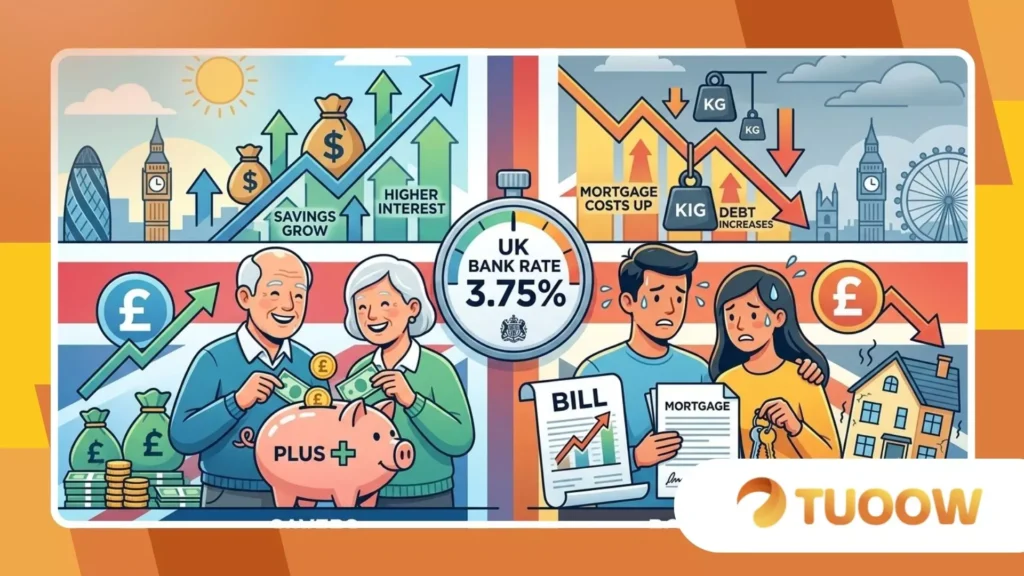
For British savers who spent years enduring near-zero returns during the post-financial crisis era, a 3.75% bank rate represents a notably healthier landscape, though it requires a proactive approach to beat inflation.
When the base rate stabilizes at this level, high-street banks frequently adjust their savings product offerings, often trimming the most generous promotional yields as competition cools.
The Shift in Instant-Access and Notice Accounts
Instant-access accounts and easy-access ISAs are usually the first to reflect adjustments in monetary policy.
As the official rate settles, banks face less pressure to attract retail deposits aggressively. Consequently, savers will often notice variable rates drifting downward.
If your money sits in a traditional high-street account paying a fraction of a percent, the real value of your cash risks eroding as the cost of living continues to evolve.
To combat this, savvy savers must look beyond standard accounts. Digital challengers and specialized savings platforms often maintain more competitive offerings to capture market share.
Utilizing cash ISAs effectively allows you to shield your returns from HM Revenue & Customs (HMRC), ensuring that your hard-earned interest stays entirely in your pocket.
Also read: Gilt yields hit new high: what it means for UK borrowers
Fixed-Term Bonds and Long-Term Planning
When interest rates stabilize around mid-range figures, fixed-term bonds become particularly attractive.
Locking your money away for one, two, or three years at a guaranteed rate allows you to insulate your savings from potential future rate cuts.
Financial advisors frequently emphasize the importance of laddering your savings splitting funds across various maturity dates to maintain liquidity while securing competitive yields.
Impact on UK Borrowers: Managing Mortgages, Loans, and Credit
While savers look for high yields, borrowers face the opposite challenge: managing the ongoing cost of debt.
A 3.75% bank rate directly influences the pricing of residential mortgages, personal loans, credit cards, and overdraft facilities across the UK market.
Navigating the Mortgage Market
For homeowners, the mortgage market remains the single biggest financial exposure tied to the base rate.
Those sitting on Standard Variable Rates (SVRs) or Tracker Mortgages will see their monthly repayments fluctuate directly in line with central bank adjustments.
When the rate sits at 3.75%, tracker mortgage holders experience predictable, moderate monthly outgoings compared to the turbulent spikes seen during previous tightening cycles.
However, borrowers whose fixed-term deals are expiring face a stark reality check. Transitioning from a legacy ultra-low fixed rate of 1.5% or 2% to a modern deal priced around current market conditions requires careful budgeting.
Mortgage brokers across the UK routinely advise locking in new deals up to six months before an existing product expires to secure favorable terms and avoid falling onto punishing SVRs.
Read more: NS&I savings products: why demand is rising among savers
Personal Loans and Revolving Credit
Beyond property finance, unsecured borrowing also feels the impact.
Personal loans offered by major lenders become moderately more expensive, making careful shopping around essential before financing home improvements, vehicle purchases, or debt consolidation.
Meanwhile, credit card providers and overdraft facilities maintain high Annual Percentage Rates (APRs), meaning that carrying a rolling balance remains an expensive endeavor regardless of minor adjustments to the official bank baseline.
Comparative Overview: Savers vs Borrowers at a Glance
To better understand how financial institutions treat different consumer segments under current monetary policy, the following table outlines the key differences in product availability, typical yields or costs, and strategic considerations.
| Financial Category | Current Environment Impact | Typical Product Behavior | Strategic Consumer Focus |
| Instant-Access Savings | Yields adjust downward as bank competition moderates. | Variable rates fluctuate; high-street banks lag behind digital challengers. | Shop around for challenger bank apps offering superior introductory bonuses. |
| Fixed-Term Savings | Offers certainty against potential future rate reductions. | Rates remain competitive as banks lock in medium-term liquidity. | Consider bond laddering to balance accessibility with guaranteed returns. |
| Tracker Mortgages | Direct correlation with the official base rate movements. | Monthly payments remain stable but reflect the baseline cost. | Monitor economic forecasts to determine whether switching to a fixed rate is wise. |
| Unsecured Personal Loans | Borrowing costs stabilize at moderate commercial levels. | Fixed repayment schedules help insulate existing borrowers from volatility. | Compare APRs thoroughly and prioritize overpayments on high-cost revolving debt. |
Expert Strategies for Safeguarding Your Personal Finances
Navigating an economy influenced by a steady monetary baseline demands discipline and foresight.
Whether you are building wealth or managing liabilities, implementing structured financial habits can protect your household budget from unexpected shocks.
First, conduct a comprehensive audit of all your active financial accounts. Many consumers lose hundreds of pounds annually simply by leaving funds in stagnant current accounts or paying uncompetitive interest rates on legacy borrowing products.
Moving idle cash into higher-yielding accounts or utilizing automated transfer rules can significantly improve your net financial position without requiring drastic lifestyle changes.
Second, prioritize emergency cash buffers. Financial planners generally recommend holding three to six months’ worth of essential living expenses in an easily accessible savings pot.
This cushion ensures that you never have to rely on expensive credit cards or unsecured loans if unexpected expenses arise, such as home repairs or temporary income disruption.
Finally, consult qualified independent financial advisors (IFAs) registered with the Financial Conduct Authority (FCA) before making major long-term commitments, such as restructuring large property portfolios or altering pension contributions.
Personalized professional guidance ensures that your financial strategy aligns seamlessly with your overarching life goals and risk tolerance.
Conclusion
The establishment of a 3.75% bank rate marks a pivotal chapter for the UK economy, striking a delicate balance between encouraging prudent saving habits and keeping borrowing costs manageable for households and businesses alike.
While savers must remain vigilant to beat inflation through digital platforms and fixed-term products, borrowers must proactively manage expiring mortgage deals and minimize high-interest unsecured debt.
By understanding these macroeconomic shifts and taking proactive steps to optimize your personal finances, you can successfully turn monetary policy adjustments to your advantage.
Frequently Asked Questions
How quickly do high-street banks change their rates after a base rate adjustment?
Commercial banks typically adjust their variable savings and tracker mortgage rates within weeks of a central bank announcement.
However, instant-access savings rates set by traditional high-street lenders often adjust much slower, meaning consumers frequently need to switch providers manually to secure better deals.
Is it better to choose a fixed-rate or variable-rate mortgage in the current climate?
The choice depends entirely on your risk appetite and personal financial stability.
A fixed-rate mortgage provides complete budgetary certainty, protecting you from future market volatility, whereas a variable or tracker rate may save you money if overall market rates trend downward.
Consulting a whole-of-market mortgage broker is recommended to evaluate your specific circumstances.
How does inflation interact with a mid-range bank rate?
Inflation measures the rising cost of everyday goods and services.
If inflation remains higher than the interest rate you earn on your cash savings, the purchasing power of your money declines over time.
This phenomenon, known as negative real returns, highlights why seeking out competitive savings yields remains vital.
Are cash ISAs still worth utilizing when rates stabilize?
Yes, cash ISAs remain an invaluable tool for UK taxpayers.
By sheltering your interest earnings from income tax particularly if your savings generate returns that exceed your Personal Savings Allowance ISAs ensure that your wealth compounds more efficiently over the long term.
